A House bill would write the CDL fraud tipline into law — hotline, web form and annual reports to Congress
Rep. Dave Taylor's CDL Fraud Tipline Act, introduced Nov. 12 with 10 co-sponsors, would require DHS and DOT to operate and maintain the September ICE-DOT hotline by statute, add an email or submission-form channel and a website, and report tips and fraudulently issued CDLs to Congress every year, by state.
Summarized from Overdrive.
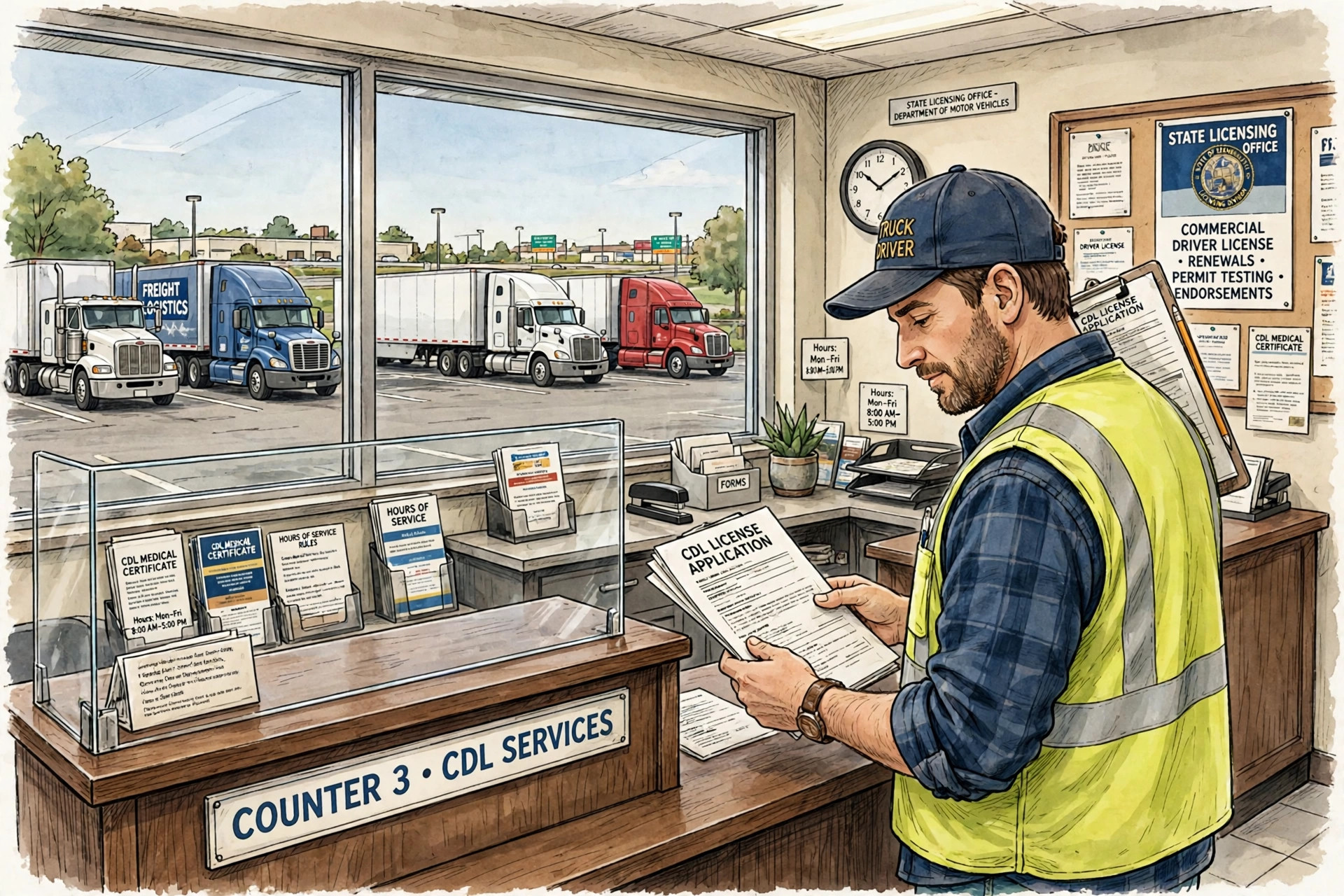
Image: Illustration: AI-generated by CDLWire
Legislation introduced Nov. 12 in the U.S. House would codify a tipline within the U.S. Department of Homeland Security for reporting fraudulent CDL activity, according to Overdrive on Nov. 16 — turning a hotline the administration stood up in September into a permanent statutory duty, with reporting channels and annual accounting the current arrangement does not require.
The bill is Rep. Dave Taylor's "CDL Fraud Tipline Act," introduced by the Ohio Republican with 10 co-sponsors. Its core provision would require DHS and DOT to coordinate to "operate and maintain the hotline, known as the 'Commercial Driver's License Fraud Tipline,' to receive information with respect to suspected fraud related to the issuance of commercial driver's licenses to aliens who are unlawfully present in the United States," the text of the bill states. That scope is worth reading carefully: the tipline the bill writes into law is aimed at suspected fraud in the issuance of CDLs to people unlawfully present in the country — the non-domiciled licensing fight that has run through CDLWire's coverage all fall, from state downgrade decisions to the federal funding case New York won in the Second Circuit — not at CDL fraud of every kind.
The hotline itself already exists, which is what makes this a codification bill rather than a creation bill. DHS established the tipline back in September between its Immigration and Customs Enforcement agency and the Department of Transportation, and anyone with information about suspected CDL fraud can call (866) 347-2423 today, without waiting for Congress. What a statute adds is permanence and structure: an administrative tipline can be reorganized, stripped of funding or quietly retired by a later administration, while a tipline Congress has required by law has to be operated and maintained until Congress says otherwise.
The bill's other two provisions build the structure out. It would require the departments to establish an email address, submission form, or another method for people to submit information to the tipline — and a website providing information about submitting — similar to the system set up by Indiana Sen. Jim Banks earlier this year with his "Truck Safety Tipline." A phone line alone limits who reports and how: a carrier safety director, a licensing-office employee or a driver with documents to share has more to send than a voice call comfortably carries, and a form-and-website channel is the difference between a tip line that takes messages and one that can receive evidence. Finally, the bill would require annual reports to Congress on how many tips are received per year and the number of fraudulently issued CDLs reported in total, broken down by state of issuance. That reporting duty matters beyond oversight bookkeeping: a state-by-state count of reported fraudulent issuances, published every year, would give the state licensing agencies at the center of the non-domiciled fight a common set of numbers to answer to — and give Congress a recurring measure of whether the September tipline is surfacing a large problem or a small one.
Procedurally, the bill starts where most bills end. With its introduction, it was referred to the House Committee on Transportation and Infrastructure, and no further action is reported in Overdrive's account. The session clock is the hard constraint, and Overdrive states it plainly: as the current Congressional session is winding down, if action is not taken on the bill before the 120th U.S. Congress convenes on Jan. 3, 2027, it will need to be reintroduced in the new legislative session. A bill introduced on Nov. 12 of a session's final weeks, still in its first committee, is therefore best read as a marker — the text its sponsors want on the record, ready to move in this session if a vehicle appears or to be reintroduced in January with the committee referral as its starting point rather than its finish.
For drivers, nothing about the bill changes what happens at a licensing counter or a roadside inspection this week, and the tipline it would codify is already live at the number above for anyone with information about suspected CDL fraud of the kind it covers. What the bill would change, if it moves, is the durability and visibility of that channel: a statutory hotline with a public submission form, a website, and an annual state-by-state report to Congress is harder to ignore — by agencies, by states and by the next administration — than a September press-release hotline. CDLWire will follow the committee.
Sources
Related coverage
 November 16, 2026 · RegulationsThe 121 revoked ELDs came from just 84 providers — and more than half of this year's revocations trace to repeat names
 November 14, 2026 · RegulationsTrucker Bathroom Access Act gets a Senate markup five days after introduction
 November 13, 2026 · RegulationsAppeals court throws out the $73.5 million funding cut FMCSA imposed on New York over non-domiciled CDLs
Comments
Loading comments…